How many countries are there? Why every travel counter disagrees
193, 195, 197 or 330: the number of countries in the world depends on who is counting. Here is how the lists differ and how Mapogo counts.
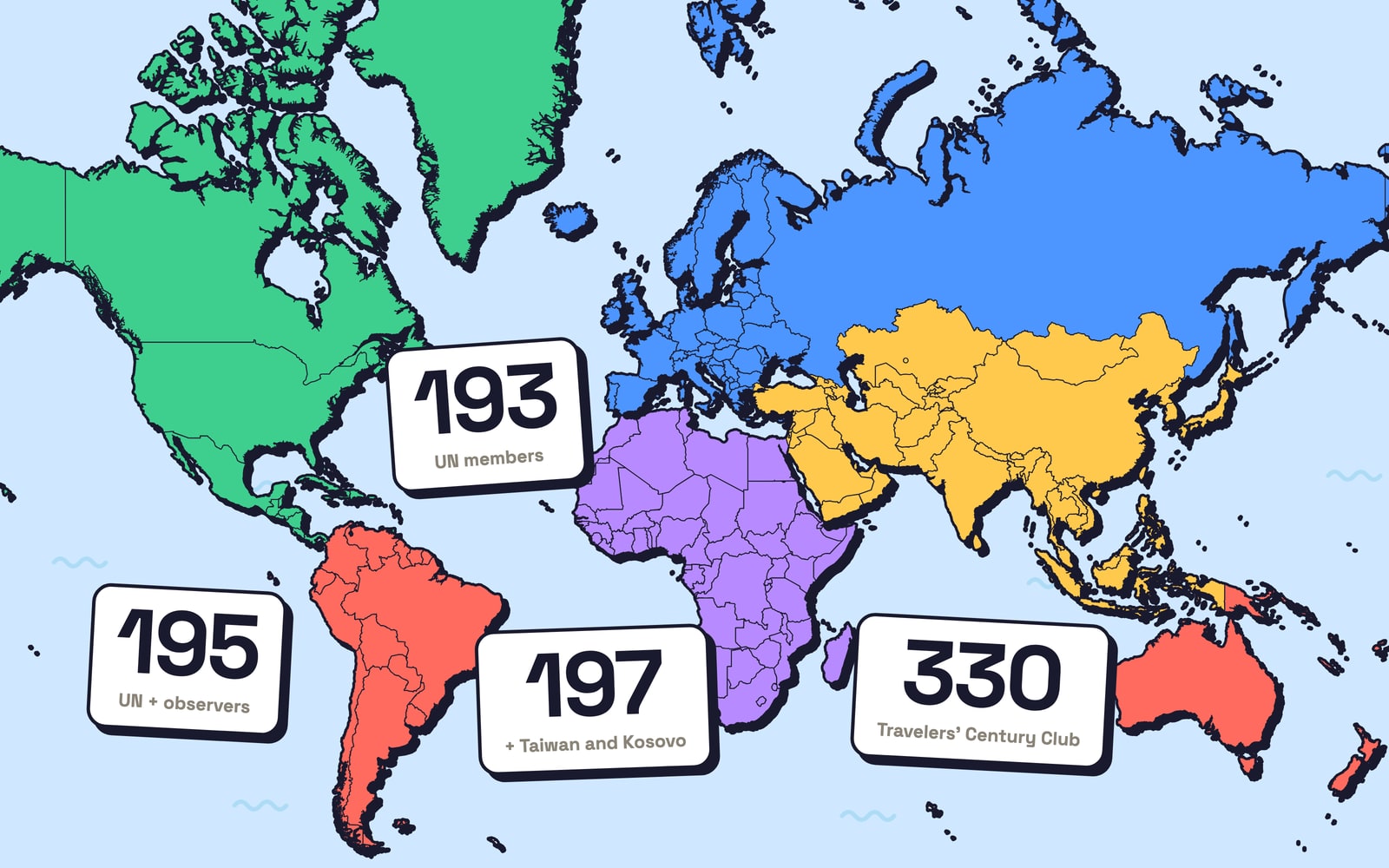
The number of countries in the world depends on which list you use. These are the common ones, and the one Mapogo uses.
The United Nations: 193
The UN has 193 member states. This is the most common baseline, and the list with the fewest arguments, because membership is a matter of record rather than opinion.
Two places sit alongside it as permanent observer states: Vatican City and Palestine. Count those and you get 195, the number you will see on most “every country” travel blogs, and the one behind Mapogo’s All UN Countries badge.
The places the UN list leaves out
A handful of places function as countries in every practical way but are not UN members.
- Taiwan issues its own passports, runs its own airports and stamps you in and out. It is not a UN member.
- Kosovo declared independence in 2008 and is recognised by over 100 states, but not by the UN as a whole.
- Western Sahara, Northern Cyprus, Somaliland, Abkhazia and a few others are recognised by some states or none.
Add Taiwan and Kosovo to the 195 and you reach 197, another number you will see quoted as “the real total”.
The travel clubs: 330 and beyond
Serious country collectors mostly ignore all of the above and use a club list instead.
The Travelers’ Century Club counts 330 “destinations”. Its list splits places that are politically one country but geographically or culturally separate, so Hawaii, Alaska and the contiguous United States are three destinations, and Sicily counts separately from mainland Italy. The rule of thumb is that a destination has to be far enough away, or different enough, that visiting it is its own trip.
NomadMania goes further, dividing the world into 1,301 regions. Under that system, seeing “all of France” means Corsica, French Guiana and a dozen metropolitan regions, not one stamp at Charles de Gaulle.
Neither list is wrong. They answer a different question: not how many countries exist, but how much of the world you have seen.
Territories, and the honesty problem
The trickiest cases are territories. Puerto Rico is part of the United States, but a trip there feels nothing like a trip to Ohio. Greenland belongs to the Kingdom of Denmark and is 50 times the size of Denmark proper. French Polynesia is, on paper, France.
Most collectors handle this with a personal rule and stick to it. The common ones:
- Sovereign states only. Clean, defensible, and it means Tahiti does not count. Some people are fine with that.
- Sovereign states plus inhabited territories. Greenland, Puerto Rico and the Faroe Islands all count. This is roughly what the 330 list formalises.
- Regions. You count states, provinces and departments, and a country is “done” when its regions are.
Whichever rule you pick, say which one you are using when you quote a number.
How Mapogo counts
Mapogo keeps the lists separate rather than blending them, so a number in the app always means one clear thing.
- Countries are the places drawn on the world map: the UN members and observers, plus places that operate as countries in practice, Taiwan and Kosovo among them, and territories like Greenland and Puerto Rico. The All UN Countries badge tracks the 195 on its own, so a visit to Taiwan colours the map but does not move that badge.
- Regions are first-level administrative divisions: US states, Canadian provinces, Japanese prefectures and their equivalents. Marking a region marks its country for you.
- Cities are their own tally, and marking one marks its region and country.
- Continents are seven, and Antarctica counts.
The stats screen shows all of these side by side. If you want to compare notes with a Travelers’ Century Club member, the region count gets you much closer than the country count does.